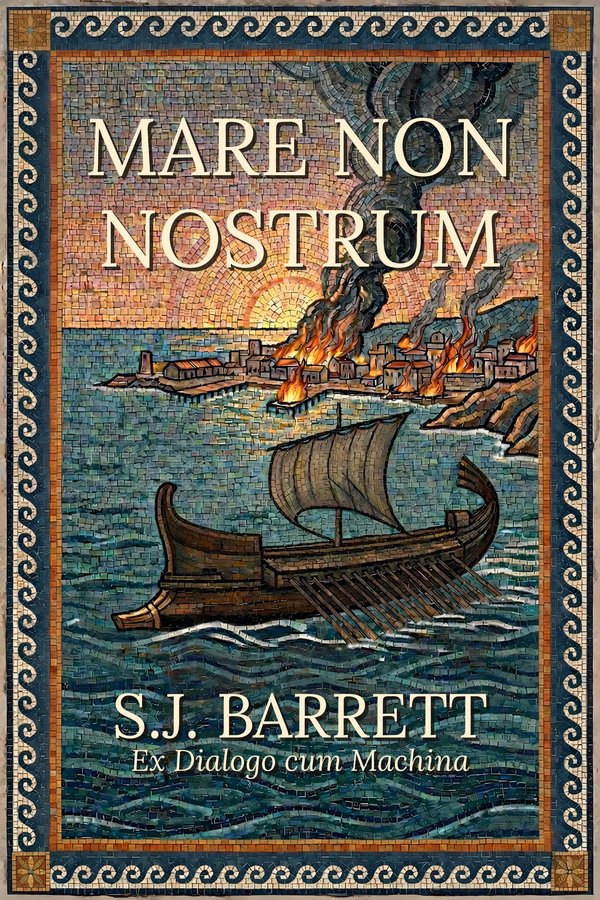
Mare Non Nostrum
S.J. Barrett · Ex Dialogo cum Machina*
Rome's problems produced violence, which at least had the virtue of clarity. Carthage's problems produced meetings.
A Carthaginian merchant-captain. Not an admiral, not a statesman, not the kind of man whose victories produced events anyone thought worth painting. But in the wreckage of Carthage's first naval defeat, he saw something Rome's enemies always missed — and set a different history in motion.
Mare Non Nostrum is the story of the war he fought and the four and a half centuries of consequences that followed. A land power and a sea power, each transformed by the existence of the other. The institutions that held, the crises that broke them, the wars that didn't happen and the ones that did. A Mediterranean where great men consistently failed and where power belonged to the people who understood systems and patience.
Then, on a remote volcanic island, a woman from a small cult combs the beaches and watches the wind. A mysterious bush in a temple. Forty-three pieces of wood. Her grandfather's log.
New to Carthage? A short, optional orientation for readers coming in cold: The Other Half of the Sea →
Every civilisation mints its own metaphors from its own history. Mare Non Nostrum tells four and a half centuries of an alternate Mediterranean — and these are some of the phrases its events left in the language, reached for generations later, the way we reach for ours.
A claim dressed as a fact. To the Romans who lost the sea, an aspiration spoken as destiny; in Carthaginian mouths, a taunt for any Roman who gives them a target.
“She’s said no three times.” “Mare nostrum.” — His friends look at each other.
A small, overlooked force that proves decisive. Never dismiss the minor player.
“You’re sending one cart?” “One cart with the right driver. Eleven ships.”
A request that will never be meaningfully answered, no matter how carefully crafted.
“I told the landlord about the roof six times.” “And?” “Petition to Carthage.” “Still leaking?” “In new places.”
Ex Dialogo cum Machina is meant literally. Ex — from, out of: the book came out of the exchange. Dialogo — dialogue, rather than auxilio (with the help of) or opera (by the work of): because the dialogue was the work, not assistance with it. Cum machina — with a machine: because the machine is what it is, and the word claims nothing more.
Mare Non Nostrum was written through sustained dialogue with a language model (Claude, made by Anthropic) — the author holding the vision and steering every decision, the model producing the prose under argument.
Three essays accompany the book. Argued Into Existence walks through how it was made, from the inside; On Authorship takes up what it means to call this writing; The Empty Chair steps back to make the general argument — where authorship lives when a model renders the prose, and why the reflex that says no one wrote it is wrong. They can be read independently — start with Argued Into Existence.